




Brain Waves and Their Usefulness
Introduction
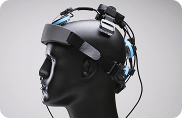
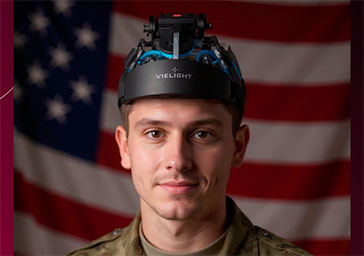
At Vielight, we work tirelessly to offer products that are helpful to improve brain functions. A large part of this relates to the use of photobiomodulation (PBM) to modulate brain waveforms. Here we share why this understanding is useful, starting with the neurofeedback practitioners’ perspective.
Neurofeedback training and the brain
Every brain is unique. Neurofeedback practitioners know that our brains respond to external stimuli in a variety of ways. These sensory stimuli can be helpful in modifying the brain’s responses when those responses are abnormal.
Neurofeedback training is based the principle that the brain uses sensory inputs to learn. Repeated information patterns indicate to your brain how to best prioritize received information. They also teach the brain response strategies to help it to interact most effectively with its immediate environment.
During a neurofeedback session your brain will receive cues based on changes in its attention and arousal. After some repetition, your brain learns which cortical behaviors have greater impacts on auditory or visual feedback patterns. As it learns, the brain begins to generate more of those desired responses and behaviors. Instead of traditional psychological “stick and carrot” techniques, neurofeedback targets the brain directly by employing various forms of stimulation.
Furthermore, neurofeedback training helps to train the brain to react differently to a stimulus or a set of stimuli in order to change an individual’s reaction. Brain wave frequencies, or neural oscillations, can play important roles in this process because they are present during specific brain states.
Brain oscillations, neurofeedback training, and photobiomodulation
Neural oscillations and brain states
Every brain state is associated with a particular band of brain frequencies, or rhythms. These rhythms are called “neural oscillations” because they are created by a multitude of neurons communicating with each other. These neural oscillations or brain waves can be registered and measured using an electroencephalogram, or EEG.
There is a correlation between a brain state and the type and frequency of neural oscillations produced during this state. It is possible that by stimulating a particular brain wave frequency, brain activity associated with this frequency can be modulated. Research shows that transcranial photobiomodulation (tPBM) can be effective in stimulating and modulating the brain.
Interventional and non-interventional ways to affect brain oscillations
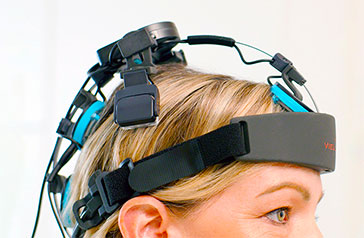
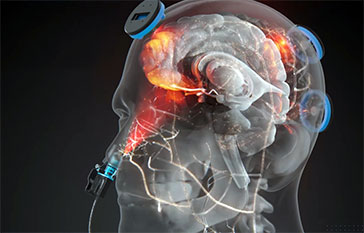
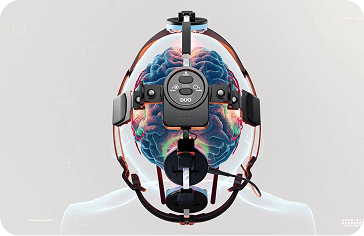
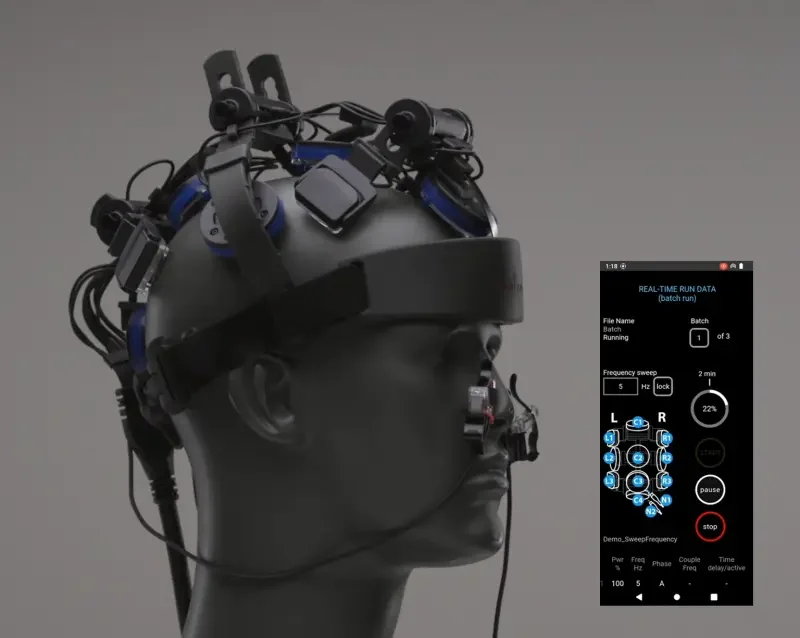
EEG is an important part in neurofeedback training. It is a useful, non-interventional method of capturing brain state data and allowing for its analysis. In addition to non-interventional tools like EEG, the neurofeedback training also requires interventional tools. Brain photobiomodulation is one such interventional tool offering a non-invasive form of brain stimulation and modulation using light energy.
While brain PBM can start a restorative biochemical reaction in the neurons, it can also affect the brain’s natural oscillations. It can help to increase or decrease these oscillations, stimulating the brain to change its response. To achieve this goal, the light that is emitted during a tPBM session is pulsed at a specific frequency that is similar to natural brain oscillations. The choice of the pulse rate depends on the issue at hand and on the desired outcome.
A neurofeedback specialist uses equipment to map brain frequencies with qEEG, or quantitative electroencephalogram. Such frequency mapping can be helpful in assessing some deficiencies and abnormalities in the brain’s responses. Furthermore, the brain frequency mapping provides an image of brain oscillations and their respective frequency bands. These brain wave bands are defined differently by different contributors to the field. However, they are most commonly classified into the following five frequency band categories: delta, theta, alpha, beta, and gamma.
What are unique brain wave frequencies?

Brain’s delta wave frequency band — 0.1 Hz to 4 Hz
Delta frequencies fall in the range of around 0.1 Hz to 4 Hz, and constitute the lowest range of brain frequencies. Brain activity in this frequency range correlates with the states of deep sleep, along with some anomalous processes.
In addition to being present in stages 3 and 4 of sleep, delta frequencies are also commonly predominant in infants under one year. The delta waves are the slowest and have the highest amplitude. They help the brain to focus inwardly, while decreasing awareness of the outside environment. These waves are helpful in attaining a state of connection with the unconscious mind.
High-performing individuals are able to decrease their delta waves to attain top levels of performance. On the other hand, individuals who are unable to decrease their delta wave activity in the brain can experience difficulty focusing. For example, individuals with attention deficit disorder (ADD) usually experience elevated delta wave activity when attempting to focus. Therefore, individuals with ADD have limited ability to stay focused and pay attention. This inability to focus can occur in anyone who has abnormal and unsuppressed delta wave reactions.
The inability to regulate delta wave activity impedes an individual’s ability to react fast to external stimuli. It can also be the cause of an inability to navigate the outside world with ease.
Brain’s theta wave frequency band — 4 Hz to 8 Hz

Brain oscillations in the theta waves frequency band fall between approximately 4 Hz and 8 Hz. The brain activity in this frequency range often correlates with creativity, emotions, and sensations. Theta brain frequencies are present during inwardly focused brain activity, as well as the transitional state between alertness and sleep. Theta oscillations are often prominent during states of creative activities, meditation, and spiritual contemplation.
Furthermore, activity in the theta range correlates with states of learning and memory creation and integration. It can also be present during anxious episodes.
In comparison with delta waves, theta waves are faster. However, despite representing faster brain activity, they are also present during sleep. Theta wave activity commonly correlates with distracted or dreamy states and experiences.