

Contact us!     1-877-355-8012  /  info@vielight.com

Vielight Logo
0

Your cart is currently empty.

Vielight Shop
0

Your cart is currently empty.

Vielight Logo
0

Your cart is currently empty.

Can Light Penetrate the Skull?

Can light penetrate the human skull and reach the brain? This question often arises among both skeptics and scientists.

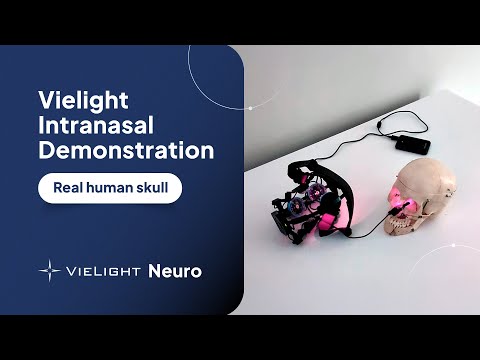
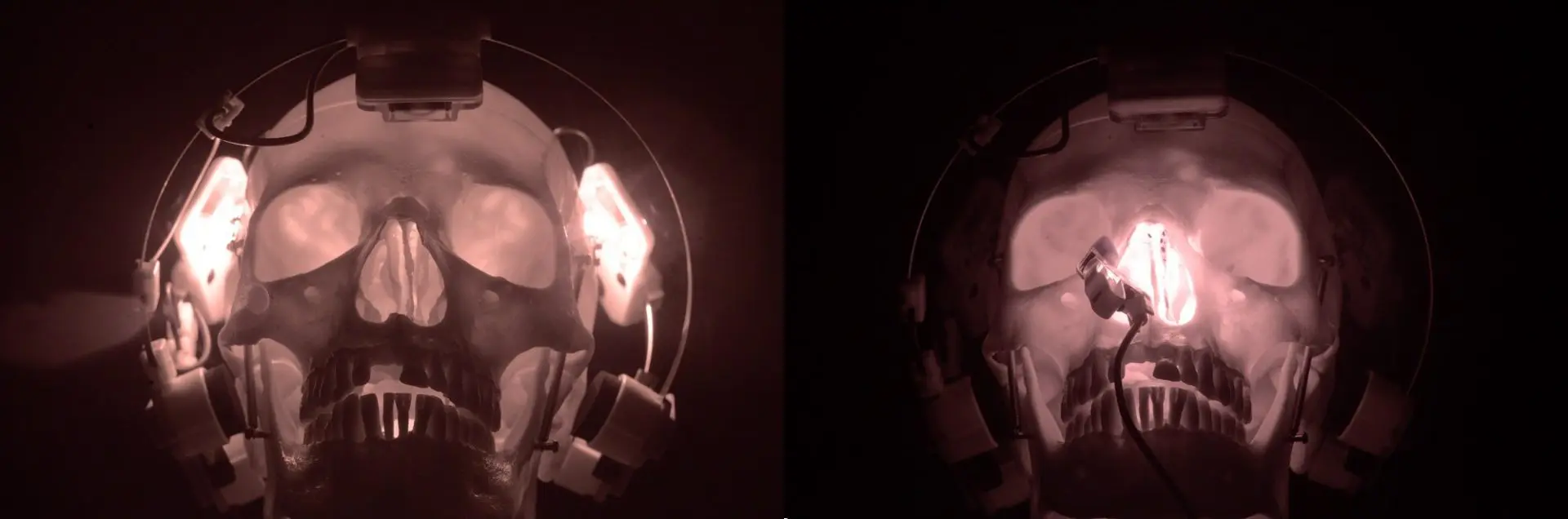
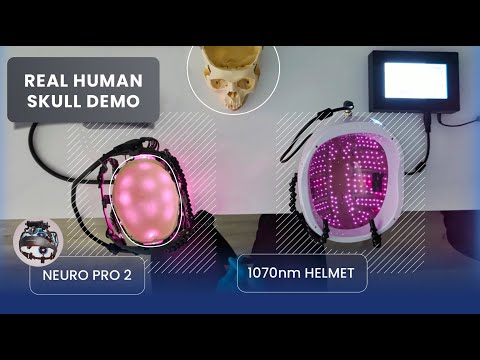
The answer is yes but with caveats; this requires an appropriate wavelength (nm) and sufficient irradiance (mW/cm²) In this demonstration with a real human skull, the Vielight Neuro, emitting 810 nm near-infrared light at an industry-leading irradiance of 250 mW/cm², clearly passes through the skullcap.

With the highest irradiance in the brain photobiomodulation field and the most published research in the industry, Vielight has set the benchmark for depth of penetration and the most published brain photobiomodulation studies.

Watch the video here:
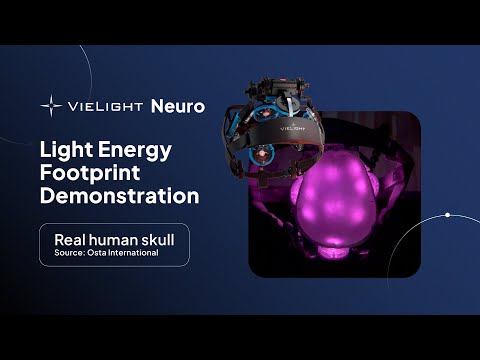
810nm light energy penetration through a human skull with the Vielight Neuro.

Firstly, why deliver light energy through the skull?

The discovery that red to near infrared light energy produces beneficial effects within neurons is groundbreaking. Near-infrared light stimulates a photosensitive enzyme, cytochrome c oxidase, that’s found within mitochondria – which leads to increased cellular energy, leading to a process known as “brain photobiomodulation”. By stimulating cytochrome oxidase activity, transcranial photobiomodulation increases neuronal energy levels – leading to increased gamma brain oscillations, brain plasticity and cognitive flexibility.[1]

However, this non-invasive, chemical-free brain enhancing stimulation wouldn’t be possible, if near infrared light energy couldn’t reach the brain in the first place.
What is near infrared light energy?

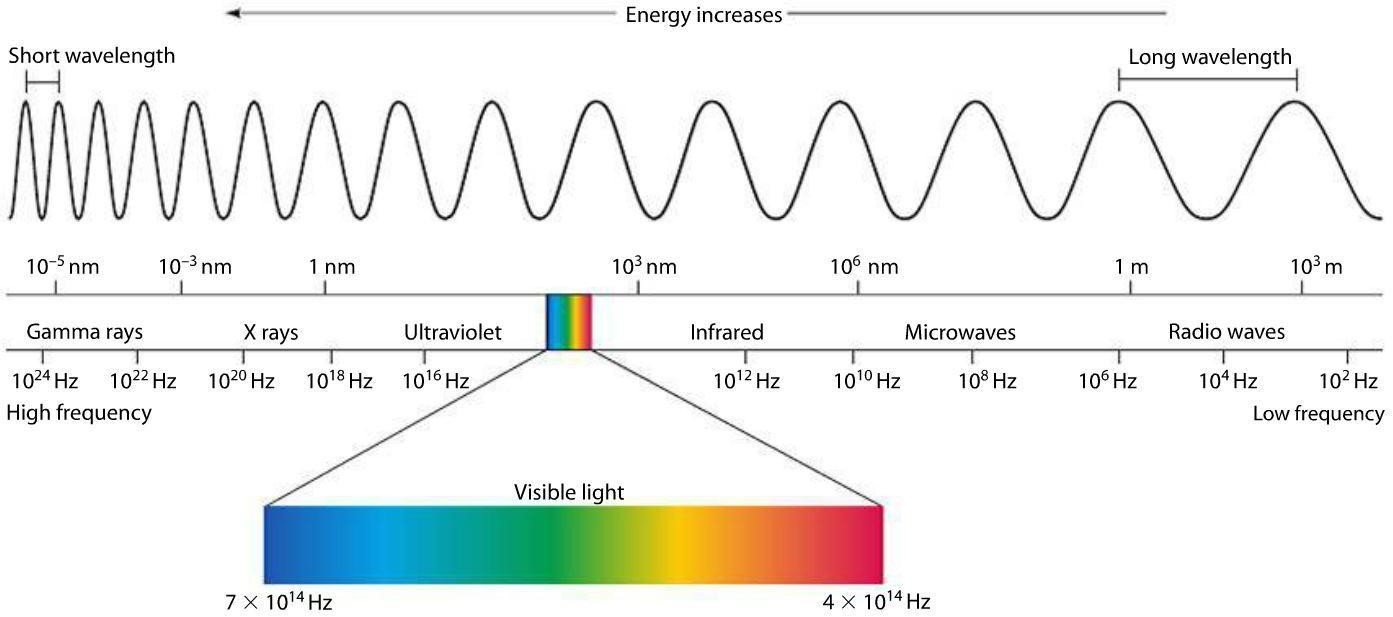
Near infrared light (NIR) energy is part of the electromagnetic spectrum – which are waves (or photons) of the electromagnetic field, radiating through space, carrying electromagnetic radiant energy. At this day and age, several existing technologies depend on the ability of electromagnetic energy to penetrate solid objects. Several examples include WiFi, mobile data, radar and navigation satellites.
The depth or the power of penetration by light energy depends on the wavelength in the electromagnetic spectrum. Thus, the longer the wavelength, the greater the ability for photons to penetrate an object. For example, near infrared light is found around the center of the electromagnetic spectrum.

The distribution of photon fluence at 660 nm, 810 nm, 980 nm and 1064 nm. Wang P, Li T. “Which wavelength is optimal for transcranial low-level laser stimulation?” J. Biophotonics. 2019; 12:e201800173. https://doi.org/10.1002/jbio.201800173

Does 810 nm or 1064 nm (1070nm) penetrate deeper into the brain?

According to a transcranial brain photobiomodulation (PBM) study by Harvard Medical School, Department of Psychiatry, the 810nm wavelength has been found to be superior to other wavelengths, which includes higher wavelengths in the 1070nm range for penetration and dosimetry.

According to this study by Harvard Medical School, the order of penetration and dosimetry effectiveness is:

  1. 810 nm – consistently highest across all age groups and regions

  2. 850 nm and 1064 nm – next most effective in most cases

  3. 670 nm and 980 nm – lesser deposition overall

This Harvard study is also supported by another brain PBM dosimetry study by leading Chinese universities, comparing 660 nm, 810 nm, 880 nm and 1064 nm. They discovered that the distribution of photon fluence at 660 and 810 nm within the brain was much wider and deeper than 980 and 1064 nm.

The differences in dosimetry is supported by a well-established biological principle, the body’s first optical window. While, the 1064 and 1070nm wavelengths are longer and scatter less than 810nm, they are more strongly absorbed by water, which is abundant in biological tissues. This increased absorption by water can lead to reduced photonic availability and tissue penetration despite the longer wavelength, which the Harvard Medical study and Peking Medical University study reveal.

The near infrared window or body’s optical window. Image source: Wang, Erica & Kaur, Ramanjot & Fierro, Manuel & Austin, Evan & Jones, Linda & Jagdeo, Jared. (2019). Safety and penetration of light into the brain. 10.1016/B978-0-12-815305-5.00005-1.

  • Water Absorption: Light absorption by water increases significantly beyond ~950 nm, and water is abundant in biological tissue. At 1064 nm, absorption by water becomes substantial, which attenuates the light more than at 810 nm. This increased absorption reduces the effective depth of penetration, especially for energy reaching specific chromophores like cytochrome c oxidase (CCO).
  • Cytochrome c Oxidase (CCO) Absorption: Mitochondria’s CCO’s absorption spectrum peaks around 810 nm, with a notable decrease in absorption beyond 1000 nm. This means that 810 nm light is more readily absorbed by CCO compared to 1070 nm.

Expanding on the 810nm light penetration study by Harvard Medical School

In order to reach the brain transcranially, NIR light energy must bypass several barriers – skin, blood, water and bone.

In a 2020 study comparing 810nm with 1070nm by researchers from the Harvard Psychiatry Department, they combined similar tissues together to create a simplified head model. This model contains eight different brain tissues: white matter (WM), gray matter (GM), CSF, skull, muscles, skin/muscles, fat, and blood vessels.[5]

This study involved the simulation of light deposition at five wavelengths commonly used in NIR applications—670, 810, 850, 980, and 1064 (1070) nm. These wavelengths have been widely used in published studies in photobiomodulation, many of which correspond to the absorption spectra of different tissues within the human body.

Figure 3
The average (bars) and peak (dots) energy deposition (penetration) after positioning the LED light source.
The left brain shows the ROIs that receiving the highest (red) and second highest (orange) energy deposition; the right brain shows the energy deposition map on the cortical surface.
(a) fluence at the F3-F4 sites
(b) fluence at the Fp1–FpZ–Fp2 sites

Figure 4
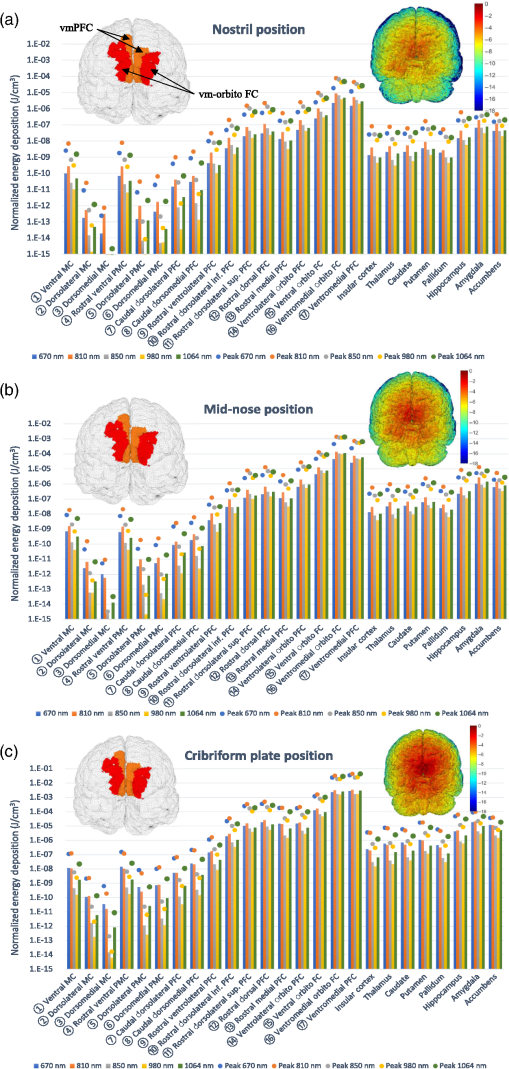
The average (bars) and peak (dots) energy deposition (penetration) after positioning the intranasal light source in the: (a) nostril, (b) mid-nose, and (c) close to the nose ceiling (in proximity of the cribriform plate)
The left brain shows the ROIs that receiving the highest (red) and second highest (orange) energy deposition; the right brain shows the energy deposition map on the cortical surface.
(a) Nostril position
(b) Mid-nose position
(c) Cribiform plate

Figure 5

Plots of the normalized energy deposition results for (a) the nostril illumination, (b) the mid-nose illumination, and (c) the cribriform plate illumination.
All results are simulated with the optical properties at 810 nm.

Conclusively, they found that the wavelength plays an important role in determining the magnitude of the energy deposition. In general, there was a clear trend showing that 810 nm offered the highest light penetration onto the brain, followed closely by 1064 and 850 nm.

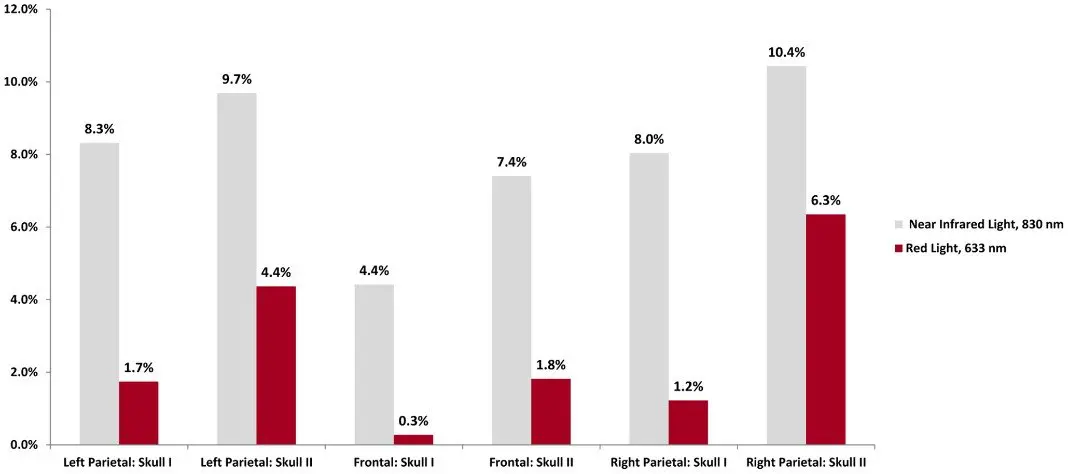
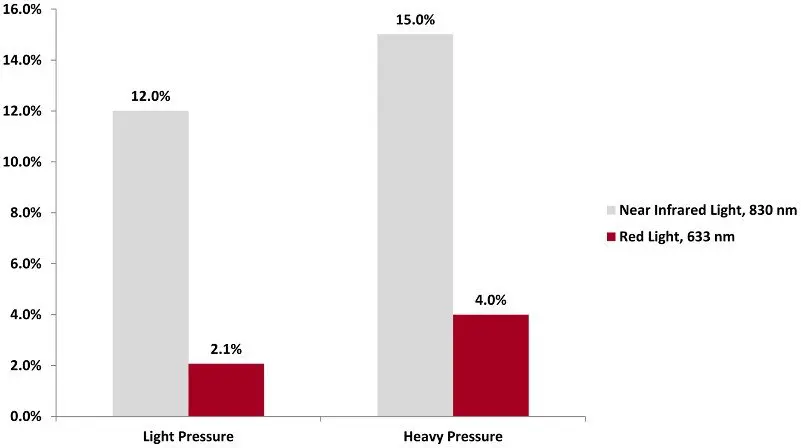
Additionally, a study done in 2012 by the State University of New York, Downstate Medical Center, compared the transmission of NIR LED light (830nm) versus visible red LED light (633nm) through soft tissue, bone, water and blood.

Here were their results from their study on the penetration of NIR light through a human head[3]:

Figure 3. Percent Penetrance of Light through Coronal Sections of Cadaver Skull, Bone Only.

Figure 4. Percent Penetrance of Light through Sagittal Sections of Cadaver Skull with Intact Soft Tissue.

Figure 5. Percent Penetrance of Light through Various Concentrations of Blood.

Figure 6. Percent Penetrance of Light through Human Cheek in vivo.

These findings demonstrate that NIR light measurably penetrates skin, bone and brain tissue in a human head model. On the other hand, there isn’t as much transmission of red light in the same conditions.

As mentioned earlier, quite a few technologies depend on the diffusion of light energy through these barriers. For example, brain imaging technology known as near infrared spectroscopy (NIRS). NIRS involves detecting changes in blood hemoglobin concentrations associated with neural activity within cortical brain tissue. Fundamentally, this technology is based on the penetration of NIR light through the cranium and into the brain, reaching up to 4 cm of depth.

Emphasis on the intranasal channel

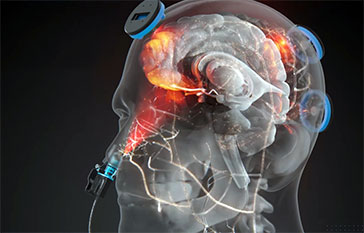
The intranasal channel is an important gateway for light energy to reach the ventral prefrontal cortex of the brain. Otherwise, this area is inaccessible through the cranium. Furthermore, the ventral prefrontal cortex plays a role in emotional responses, decision making and self control – which play important roles in performance and mental balance.

Watch how Vielight’s patented intranasal technology can reach deep brain structures through the nasal channel:

MoreMore emphasis on the intranasal channel

Additionally, a study on the intranasal diffusion of NIR light through a human head was done by the Institute of Chemical Sciences and Engineering in Switzerland. This study demonstrated that it is possible to illuminate deep brain tissues transcranially and intranasally.[4] The measurement of the fluence rate distribution was, once again, carried out on a human cadaveric head.

Figure 7 View on the 3D mesh of the skull

This study quantifies the light distribution within brain tissue when illuminating from the nasal cavity with a controlled energy deposition.

Figure 8 (a) Fluence rate distribution at 671 nm. (b) Fluence rate distribution at 808 nm.

The results obtained from the study suggests that light at 810 nm is the better choice. This is due to less absorption and reduced scattering at 810 nm in all tissue types. The increased light propagation at the 810 nm wavelength improves the penetration and diffusion rate of photons into deeper brain regions.

Figure 9 Transmission of light energy through a human cadaver with the Vielight Neuro.

Conclusion

The penetration of light energy into the brain is highly dependent on the wavelength. In light of this, several studies support the ability of near infrared light (808 – 820nm) to penetrate through the skull and up to 4 cm into brain tissue. Thus, these studies help to answer the question: “Can light penetrate the brain?” with a “Yes.”

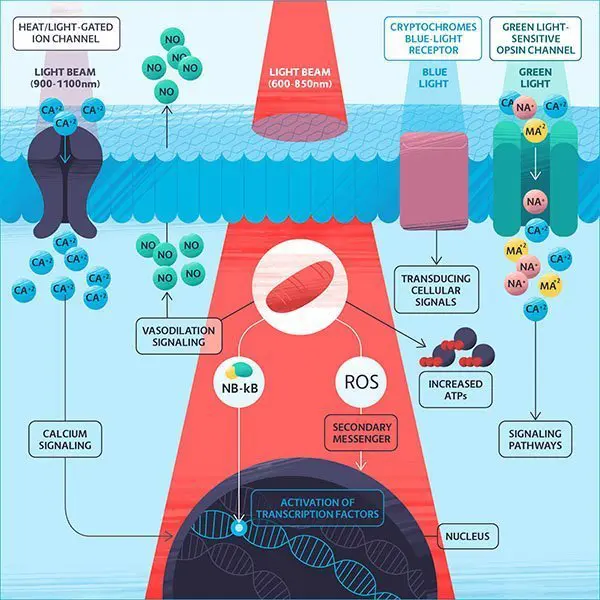
Figure 9 The light penetration difference among different wavelengths and the effects on cellular mechanisms.

Only the wavelengths in the near-infrared window of 600–850nm is absorbed by the mitochondrial electron transfer chain and leads to upregulation of the neuronal respiratory capacity. Source : Mol Neurobiol. 2018 Aug; 55(8): 6601–6636.

References

  1. Gonzalez-Lima, F; Barrett, Douglas; “Augmentation of cognitive brain functions with transcranial lasers”, Frontiers in Systems Neuroscience : doi:10.3389/fnsys.2014.00036
  2. Smith, Andrew M.; Mancini, Michael C.; Nie, Shuming (2009). “Bioimaging: Second window for in vivo imaging”. Nature Nanotechnology. 4(11): 710–711. doi:1038/nnano.2009.326. ISSN 1748-3387. PMC 2862008
  3. Jagdeo JR, Adams LE, Brody NI, Siegel DM (2012) Transcranial Red and Near Infrared Light Transmission in a Cadaveric Model. PLoS ONE 7(10): e47460. https://doi.org/10.1371/journal.pone.0047460
  4. Pitzschke, Andreas & Lovisa, B & Seydoux, O & Zellweger, M & Pfleiderer, M & Tardy, Y & Wagnières, Georges. (2015). Red and NIR light dosimetry in the human deep brain. Physics in medicine and biology. 60. 2921-2937. 10.1088/0031-9155/60/7/2921.
  5. Yuan Y, Cassano P, Pias M, Fang Q. Transcranial photobiomodulation with near-infrared light from childhood to elderliness: simulation of dosimetry. Neurophotonics. 2020 Jan;7(1):015009. doi: 10.1117/1.NPh.7.1.015009. Epub 2020 Feb 24. PMID: 32118086; PMCID: PMC7039173.

This article was written by

Dr. Nazanin Hosseinkhah

Vielight | Biomedical Physicist

Nazanin manages brain imaging research projects with photobiomodulation in collaboration with major research organizations, such as the University of Alberta and Baycrest Hospital.

PhD in Medical Biophysics, University of Toronto
Meet the author
0